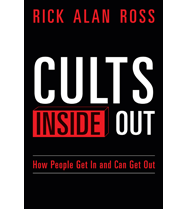
Psychologists reveal 5 signs your workplace culture has quietly crossed into cult territory — and most employees only notice them on the drive home, replaying a meeting they can’t quite explain
Published By admin
There’s a particular kind of silence that happens in the parking lot after a mandatory all-hands meeting. You’re sitting in your car, keys in the ignition, replaying something the CEO said about “family” and “sacrifice” and “those who don’t get it.” You can’t quite name what felt wrong. The words were fine. Everyone clapped. But your chest is tight, and you’re already composing an email in your head about why you can’t make the weekend team-building retreat.
If you work in a high-pressure environment—tech, finance, nonprofits, consulting, startups—you’ve probably experienced this exact moment. You belong to a workplace culture that sits somewhere on a spectrum, and lately you’re wondering if you’ve drifted further toward one end than you realized. This article is about you: the person who loves the work, respects many of the people, but has started noticing patterns that don’t quite add up. Psychology suggests there are specific behavioral signals that mark the line between a demanding culture and something closer to coercion. Most employees only recognize them on the drive home.
Does Disagreement Feel Safe in Your Workplace?
Disagreement with strategy gets treated as betrayal of the team.
In healthy organizations, pushback is friction—necessary, sometimes productive. In cultures that trend toward coercive control, disagreement becomes a character question. You’ve noticed this: when someone questions a decision in a meeting, the response isn’t “let’s examine that assumption.” It’s a subtle shift in how that person is treated afterward. They’re labeled as “not aligned.” They’re left off emails. Their contributions get smaller. The message is clear without being spoken: loyalty means compliance.
It’s the colleague who raised a concern about unrealistic timelines and was quietly moved to a different project. It’s the way your manager’s tone changes when you say “I need to push back on this.” It’s the knowledge that speaking up costs something, so you’ve learned to stay quiet in meetings and text your real thoughts to a friend who also works there. This pattern of communication patterns often reflects deeper organizational dynamics.
The Organization Has Its Own Language and Inside Jokes
New employees are taught a private vocabulary that separates insiders from outsiders.
Every workplace has jargon. But in cultures that function like closed systems, the language becomes more than efficient shorthand—it becomes a marker of belonging. You use terms that don’t exist in the wider industry. You have phrases that only make sense if you’ve been indoctrinated into the specific worldview. Outsiders who use these terms incorrectly are gently corrected. The message is: you don’t belong here yet, but you can, if you learn.
This language also serves another function: it makes it harder to describe your experience to people outside the organization. When your partner asks what happened in that weird meeting, you can’t quite translate it. The language doesn’t work in the outside world. So you stop trying to explain, and the organization becomes more real to you than your life outside it.
Real the full artice at the link below
Content retrieved from: https://www.leravi.org/workplace-cult-culture-signs-employees-miss-18246/.