Inside a cult: How control, belief, and belonging shape lives
Published By admin
Browse through any streaming service and you may spot the fascination and preoccupation with cults in the vast array of documentaries on cults. Wild, Wild Country (Netflix), the Osho cult following in the US which led the largest bioterror attack in US history by poisoning food at local Oregon establishments in 1894, is an example of how far cults can go. Another example is Escaping Twin Flames (Netflix), a more contemporary cult following of a couple named Shaleia and Jeff Divine called Twin Flames Universe. Targeting those who’ve had trouble finding love, the Twin Flames Universe “assisted” in identifying and finding twin flames for those who signed up. The cult used strong coercion to convince members that the more they got involved and the more money they spent on finding their twin flames, the more likely it was that they would find their soulmates.
There are countless more examples, some famous and many more that aren’t high profile. According to a 2017 study published in Psychiatry Research, a cult “can be seen as an organized group or a solitary person whose purpose is to dominate cult members by using psychological manipulation and pressure strategies”. Cults play on innate human attributes such as the need to belong and be accepted. “When we interviewed former cult members regarding the factors that had encouraged them to join the cultic group, they mainly reported spirituality, personal development, and life dissatisfaction,” the study adds.
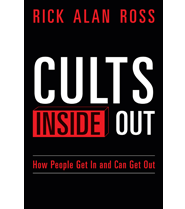
Cult expert Rick Ross of Cult Education Institute says there are warning signs to look for when attempting to recognize a cult in full force. These include: “absolute authoritarianism without meaningful accountability; no tolerance for questions or critical inquiry; no meaningful financial disclosure regarding budget, expenses such as an independently audited financial statement; unreasonable fear about the outside world, such as impending catastrophe, evil conspiracies and persecutions; there is no legitimate reason to leave, former followers are always wrong in leaving, negative or even evil; former members often relate the same stories of abuse and reflect a similar pattern of grievances; there are records, books, news articles, or television programs that document the abuses of the group/leader; followers feel they can never be ‘good enough’; the group/leader is always right; and, finally, the group/leader is the exclusive means of knowing ‘truth’ or receiving validation, no other process of discovery is really acceptable or credible.”
So if it looks like a cult, feels like a cult and behaves like a cult according to these warning signs? It is probably a cult. Tina Kapp, 44, is a cult survivor of the Family International, which began as The Children of God in 1968. Kapp was born into the cult and says, “It is the only life I knew until I was 30.”
Read more https://www.biznews.com/good-hope-project/cult-control-belief-belonging
Content retrieved from: https://www.biznews.com/good-hope-project/cult-control-belief-belonging.